Explore tables, chairs, décor, and party essentials below. Select the items you need, choose your event date, and submit a rental request — we’ll review everything and send you a custom quote.
Choose a category or search to start building your wishlist!
Tent Options
Explore our range of tent sizes and styles to find the perfect fit for your event.
Frame tent
A frame-supported tent consists of a framework of assembled aluminum pipes, often with steel fittings, that support the fabric roof and define the tent’s shape. The rigid framework allows the tent to stand without the support of a center pole.
An anchoring system is required to hold them in place. These tents can be installed on a wide variety of sites and can be an ideal alternative to pole tents on surfaces such as decks, patios, rooftops, and parking lots because they function well when typical anchors and guy lines are not practical.
They are commonly ten to fifty feet wide, and sections can be added to extend the length and form one long tent.
High Peak Tent
A frame-supported tent that features an aluminum frame with a flying center pole. The center pole sits on top of two tension cables attached to each corner of the frame. The cables criss-cross in the center, creating a connection point for the center pole. The shape of the tent top features a higher peak than what is used for standard frame tents and has sweeping lines like the tension-style pole tents.
Tension Tents
Installed similarly to the push-pole design tents, they rely on the tension of the fabric over the center poles, side poles, and secure many of the anchors to maintain their shape and strength. This style of tent does not require additional quarter poles like the traditional push- pole design. The curved shape to the fabric patterns allows the tension tent to be supported by a single or “twin” center poles.
The name “Tension” refers to a design that uses the shape or contour for the cut fabric patterns to achieve the desired strength and shape of the finished tent. Tension style tents are available in a variety of sizes and shapes. Tension tents come in two types: a lighter duty, non engineered and a heavier duty, engineered.
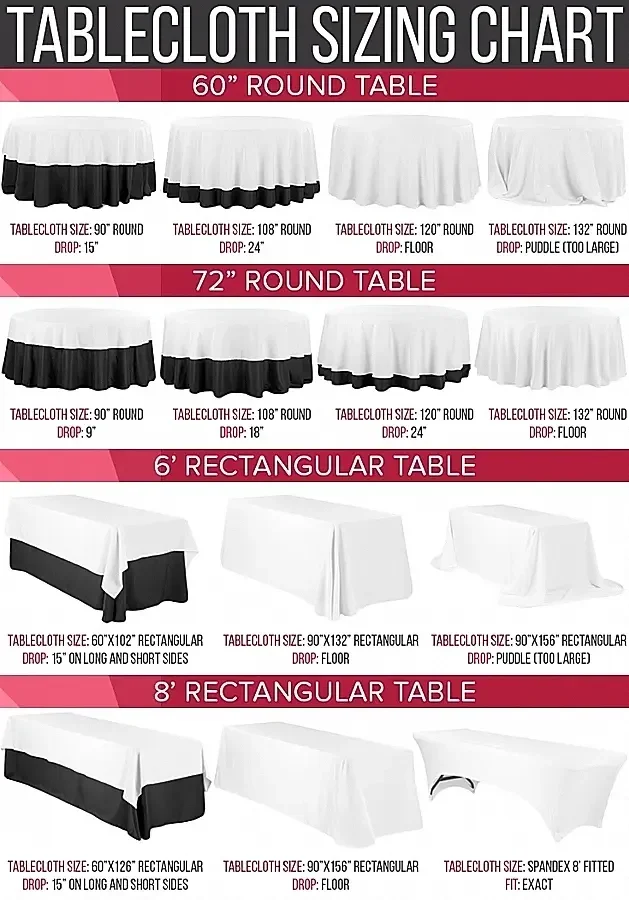
Linen Options
Choose from a variety of colors and styles to complement your event design.